With the return of football season, I’m reminded of one of the pairs of network commentators for NFL games, Joe Buck and Troy Aikman. Whenever Buck introduces his partner, he adds the new first new he has given him: Hall of Famer, “I’m Joe Buck and this is Hall of Famer Troy Aikman.”
When it comes to our own motivation to follow Jesus and motivating those under our care, it is worth noting that there is a hall of fame given by God in Scripture. Its members are identified in Hebrews 11: Abel, Enoch, Abraham, Sarah, Moses, Gideon, Rahab, Jephthah, David the prophets and others. All of these showed one distinctive attribute that got them into God's Hall of Fame—unconquerable faith. Such was the faith of Elijah the Tishbite, a giant from God’s hall of fame. Today we begin a new series that looks at Hall of Famer Elijah and what lessons can we can learn from him as a man and as a leader. This episode examines the seeds of his faith, which he lived out in a world that is as hostile to God and his kingdom as is the world we live in today.
Hall of famers in the NFL are always great athletes who were extremely skilled: Jim Brown, Lawrence Taylor, Barry Sanders, Jerry Rice, Drew Brees, Antonio Gates. Hall of famers in the business world are also extraordinarily talented as well as brilliant: Meta founder Mark Zuckerberg, Amazon Founder Jeff Bezos, Tesla and SpaceX founder Elon Musk. In striking contrast to the NFL and business world stars, God’s Hall of fame is made up of ordinary folks who wouldn’t be considered “greatness” material.
- Think of Abraham, 75-years-old and ready for retirement. God says, “I want to make of you a new nation.” That seemed especially ridiculous since at 75 he had no children and his wife was post-menopausal.
- Think of Moses, at 80 years old, minding his own business tending sheep on the back side of the desert. God says, “I want you to go back to Egypt and lead my people out of there.” What was Moses’ answer? “I’m no leader, I’m just a shepherd. Besides, I don't speak very well.”
- Consider David, the runt of the litter. He was considered so unqualified to be the future king of Israel that his father, Jesse, didn't even think of him, when the prophet Samuel said that one of his sons was going to be anointed king. Jesse gathered all his other sons to meet Samuel but left his youngest out in the field doing the menial job of tending the sheep.
- Or think of Mary, the mother of Jesus. Who was more unlikely to be the mother of God come in the flesh than this poor, teen aged, peasant girl in a rural town of less than 200 people who probably lived in a cave.
It appears that God loves to show his glory by taking ordinary people—like you and me—and making them hall of famers, when we yield ourselves to his lordship.
Today’s study begins with such an ordinary man, Elijah, a most unlikely candidate to be so powerfully used by God in his day.
BACKGROUND OF ELIJAH
Elijah is first introduced to us as the Tishbite in the 17th chapter of 1 Kings and an inhabitant of Gilead. We know very little else about him other than that he came from the mountains of Gilead on the other side of the Jordan, from a group that was something of an outcast group. He might have been from the tribe of Manasseh for that area had been given over to Manasseh's descendants. They were a hill people, strong and rugged. His birthplace was the little town of Tishbe, a small, obscure village in the mountains. His formal education was apparently not extensive and, of his earthly religious training, we know next to nothing. He and his fellow Israelites were surrounded by enemies who were idol worshippers. But Elijah had been very jealous for Yahweh (see 1 Kings 19:10). We gather from this that he was a man who was familiar with the Law of Moses, the first five books of the Bible, which prohibited idol worship of any kind and spelled out severe sanctions in the Covenant God made with Abraham’s descendants, should they worship false Gods. In his youth Elijah must have pondered at length over the blight of sin that had degraded his people. In his adult years, the spiritual condition of Israel descended to an all-time low. Here is the biblical description of the conditions in Israel just before Elijah is introduced. (From 1 Kings 16:30-33.)
And Ahab the son of Omri did evil in the sight of the Lord, more than all who were before him. And as if it had been a light thing for him to walk in the sins of Jeroboam the son of Nebat, he took for his wife Jezebel the daughter of Ethbaal king of the Sidonians, and went and served Baal and worshiped him. He erected an altar for Baal in the house of Baal, which he built in Samaria. And Ahab made an Asherah. Ahab did more to provoke the Lord, the God of Israel, to anger than all the kings of Israel who were before him. In his days Hiel of Bethel built Jericho. He laid its foundation at the cost of Abiram his firstborn, and set up its gates at the cost of his youngest son Segub, according to the word of the Lord, which he spoke by Joshua the son of Nun.
Ahab, the King of Israel had married Jezebel, the daughter of Sidonian King Ethbaal, whose very name meant “with Baal.” Jezebel not only brought Baal worship to Israel, she killed every prophet of Yahweh that she could find. She made Baal worship the state religion and paid the salaries of 850 priests of Baal and Asherah. Asherah was considered to be the consort of the male storm God, Baal. Baal worshippers practiced temple prostitution. They were told that that engaging in ritual sexual acts with male or female temple personnel would physically stimulate Baal and his consort (the goddess Asherah) to unite, thereby ensuring fertile soil, healthy livestock, and successful harvests.
Another indicator of the moral degradation brought by Baal worship, referenced in the text, was the rebuilding of Jericho by Hiel of Bethel at the cost of his two sons, Abiram and Segub. Joshua had promised a curse on anyone who might rebuild Jericho. The text does not say specifically how the two sons of Hiel died; but it is quite possible that he offered them in sacrifice to Baal. Child sacrifice was a prominent feature among the polytheistic Canaanite religions of the day, which Jezebel would have encouraged. If the sons of Hiel died by child sacrifice, this would be evidence of the striking difference between Israel's past under godly Joshua and its present under evil Ahab. Israelites no longer capture Canaanites as they did in conquering Jericho but rather the Canaanite religion captures Israelites.
BACKGROUND OF FALSE WORSHIP & IDOLATRY
CREATION. To understand the prevalence of idolatry we need to go back to God’s creation design. Augustine referred to this design when he wrote in his Confessions, “You have made us for yourself, O Lord, and our heart is restless until it rests in you.” This simple but profound statement captures our creation identity as image-bearers, designed for fellowship with God. It also describes our fallen identity as idolaters who seek to fill the God-shaped vacuum of our hearts in other futile ways. Let’s first consider the positive side of this design. In Psalm 16:11 David recognized this design, praying “In your presence is fullness of joy” and in Psalm 63 he tastes the pleasure of enjoying God, as he prays,
God, you are my God and I long for you. My whole being desires you; like a dry, worn-out, and waterless land, my soul is thirsty for you. Let me see you in the sanctuary; let me see how mighty and glorious you are. Your constant love is better than life itself, and so I will praise you. I will give you thanks as long as I live; I will raise my hands to you in prayer. My soul will feast and be satisfied. and I will sing glad songs of praise to you (Ps. 63:1-4 Good News Translation).
Paul recognized that if we don’t fill our hearts with the joy of walking with Jesus, we expose them to destructive pleasures and false intimacy. When challenging the sexually broken believers at Corinth about their sexual immorality, he did not simply say, “Stop it.” He said, “You cannot say that our physical body was made for sexual promiscuity; it was made for God, and God is the answer to our deepest longings” (1 Cor. 6:13 Phillips).
David characterized God’s commandments as more precious than gold because they show us how God designed us to live. The greatest commandment is to love the Lord your God with all your heart and with all your soul and with all your mind and with all your strength. (Mark 12:30) God designed life with a priority structure for our LOVES. When we keep him first in our affections, our LOVES remain properly ordered and life works as designed. That is why the first commandment is to have no other Gods before Yahweh. His promise is, “Delight yourself first in me; then I will give you the desires of your heart” (Ps. 37:4).
To be created in God’s image means that humans are created to be worshippers. Sociologists have found evidence of worship in every culture of the world. The naturalistic worldview of our culture has no answer to explain this difference between humans and the rest of created order. Dogs don’t worship. Porpoises don’t build altars. Humankind alone being made in God’s image have a spiritual nature that must worship.
FALL. By definition, God is the Supreme Being. But the heads of our race rebelled against that Supreme Being in disobeying his command not to eat the fruit. In Adam’s and Eve’s sin our race expressed its ultimate commitment to autonomy—to being our own God. Adam and Eve refused to worship the one we were created to worship. They refused to honor Gods authority by obeying him. And they refused to thankful for all the fruit on thousands of trees God had given, insisting instead upon partaking from the one tree forbidden to them. Paul explains the fall.
For the wrath of God is revealed from heaven against all ungodliness and unrighteousness of men, who by their unrighteousness suppress the truth. For what can be known about God is plain to them, because God has shown it to them. For his invisible attributes, namely, his eternal power and divine nature, have been clearly perceived, ever since the creation of the world, in the things that have been made. So they are without excuse. For although they knew God, they did not honor him as God or give thanks to him (Rom 1:18-21a).
After Adam and Eve sin, their guilt causes them to hide from the holy eyes of God and they are cast out of his holy presence in the Garden of Eden. Because of our guilt and shame, apart from God’s grace no human being will seek the true God. Paul writes, “There is none that seeks after God, no not one. All have turned aside” (Rom 3:11-12). But as Augustine observed, every human is created with a God-shaped vacuum. So apart from God’s grace, humans will fill that vacuum with false Gods. Romans 1:21 continues,
They became futile in their thinking, and their foolish hearts were darkened. Claiming to be wise, they became fools, and exchanged the glory of the immortal God for images resembling mortal man and birds and animals and creeping things. Therefore God gave them up in the lusts of their hearts to impurity, to the dishonoring of their bodies among themselves, because they exchanged the truth about God for a lie and worshiped and served the creature rather than the Creator, who is blessed forever! Amen (vs 21b-25).
Fallen humans fill the worship vacuum with some false God, some idol. It may be Baal or Asherah in the Ancient Near East. It may be the God of Hinduism, Buddhism, or Islam. Substituting a false God may take the form of religious adherence to Hitler, Mao, left-wing ideology or right-wing ideology. The false God we serve may be money or pleasure or security, or personal autonomy and freedom, i.e. whatever one looks to for personal fulfillment and purpose.
REDEMPTION/RESTORATION. The sacrificial system established under Moses and the Mosaic Law taught the principle of substitutionary atonement, that the shed blood of a lamb could substitute as payment for the death every human deserves for his cosmic treason against the High King. This sacrificial system was to point to Jesus, the ultimate lamb of God who takes away the sin of the world.
A second means of Grace was the giving of the Moral Law through Moses. It is always important to remember that God gave the Ten Commandments after he had redeemed Israel from slavery in Egypt, which symbolically stood for their slavery to sin. God gave the moral law not so that his covenant people could earn their way to God by keeping it. Rather, after he had set his unearned love and grace upon them and delivered them from slavery to sin, they could see how life is to be lived out in the kingdom of righteousness. The moral law has always been the pathway to both pleasing God and living as He designed life to work. In contrast, the pay out of sin is always death. So, God gave us his moral law in the form of a common cultural agreement—a covenant. The essence of the covenant was belonging, “I will be your God and you shall me my people.” The covenant, like other covenants made between conquering kings and their vassals, stipulated the blessings that would come from obedience to Yahweh and the curses that would come for disobedience. Here is just a sample of these sanctions,
And if you faithfully obey the voice of the Lord your God, being careful to do all his commandments that I command you today, the Lord your God will set you high above all the nations of the earth. And all these blessings shall come upon you and overtake you, if you obey the voice of the Lord your God. Blessed shall you be in the city, and blessed shall you be in the field. Blessed shall be the fruit of your womb and the fruit of your ground and the fruit of your cattle, the increase of your herds and the young of your flock. Blessed shall be your basket and your kneading bowl. Blessed shall you be when you come in, and blessed shall you be when you go out…
But if you will not obey the voice of the Lord your God or be careful to do all his commandments and his statutes that I command you today, then all these curses shall come upon you and overtake you. Cursed shall you be in the city, and cursed shall you be in the field. Cursed shall be your basket and your kneading bowl. Cursed shall be the fruit of your womb and the fruit of your ground, the increase of your herds and the young of your flock. Cursed shall you be when you come in, and cursed shall you be when you go out…. (Deut 28).
SUPREMACY OF RIGHT WORSHIP
There is only one passage of Scripture directly inscribed by the finger of God on Mt. Sinai. On two tablets, God’s finger inscribed The Ten Commandments, the ten moral pillars on which all the moral law stands. Let’s remember how this message from God begins. “I am the Lord your God, who brought you out of the land of Egypt, out of the house of slavery. “You shall have no other gods before me” (Ex 20:2-3). This is parallel to the greatest commandment, which Jesus quoted from Deuteronomy 6, “You shall love the Lord your God with all your heart and with all your soul and with all your might.” This commandment to order our worship and loves correctly is so important to God that it is mentioned numerous times in Scripture. Consider Deuteronomy 11:13-17. As you read this text, think about the spiritual conditions in Israel, and what Elijah is about to do.
And if you will indeed obey my commandments that I command you today, to love the Lord your God, and to serve him with all your heart and with all your soul, he will give the rain for your land in its season, the early rain and the later rain, that you may gather in your grain and your wine and your oil. And he will give grass in your fields for your livestock, and you shall eat and be full. Take care lest your heart be deceived, and you turn aside and serve other gods and worship them; then the anger of the Lord will be kindled against you, and he will shut up the heavens, so that there will be no rain, and the land will yield no fruit, and you will perish quickly off the good land that the Lord is giving you.
In short, God says, “If you worship false Gods, I will send you a drought.”
ELIJAH’S COURAGEOUS FAITH
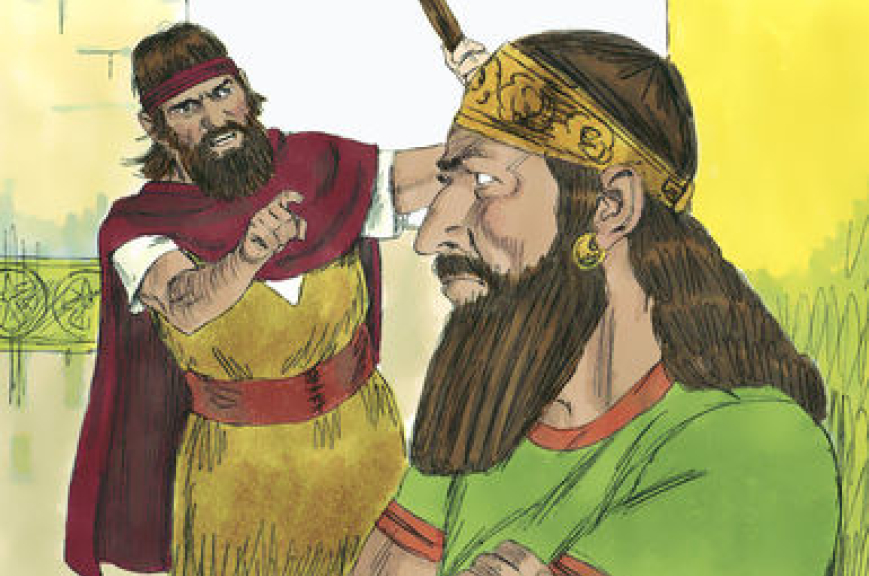
Now Elijah the Tishbite, of Tishbe in Gilead, said to Ahab, “As the Lord, the God of Israel, lives, before whom I stand, there shall be neither dew nor rain these years, except by my word” (1 Kings 17:1).
Elijah, whose name means “My God is Yahweh” courageously marches into the court of King Ahab who had not only become a worshipper of Baal but had built a temple to Baal. Think of it. In Israel, God's nation! He set up poles to worship Asherah. He's married Jezebel who is systematically rounding up the priests of Yahweh and slaughtering them. But Elijah courageously walks into the headquarters of a regime in Israel carrying out a Holocaust against true believers in Yahweh. No secret service goes with him to protect him. He could have been executed on the spot. Let’s try to identify what gave him such courageous faith.
A. His faith is based upon a mature biblical perspective. It was not his idea to one day decide to barge into Ahab's headquarters and threatened to pray that his crops would be destroyed. We don’t know exactly how God gave his message to his prophets. But it is very likely that Elijah’s actions grew out of familiarity with Deuteronomy 11. He understood that Israel was God's covenant people and understood the blessings and curses of the covenant. His prayer to stop the rain was squarely based on God's Word. The prayer promises of the Bible assume that we are discerning what to pray for by putting the lens of scripture over the situation. Jesus said. “If you abide in me and my words abide in you, ask whatever you wish and it will be done for you” (John 15:7).
B. His faith to speak to Ahab grew out of his view of his calling. Elijah saw himself as God's representative. His words were, “As Yahweh the God of Israel lives.” That introduction communicated that Elijah was representing God. It’s worth asking ourselves, “Do I think of myself as God’s ambassador to the lost?” Paul saw believers that way. He wrote “God has committed to us the message of reconciliation. We are therefore Christ's ambassadors as though God were making his appeal through us. We implore you on Christ's behalf, Be reconciled to God.” Part of Elijah's courage to speak came from recognizing his calling.
C. The third key to Elijah's faith was remembering that he would give an account to God of his life. 1 Kings 17:1 says, “As Yahweh lives whom I serve.” Elijah is one of the great examples of standing alone. What mattered to Elijah, I believe, was the account of his life that he would give to God not to human beings. Elijah’s perspective was that God's approval was a whole lot more important than man's approval. When it comes to standing for biblical truth isn't that the crux of the issue? Whose approval do we really want? I'm not saying we should necessarily be blunt, only that when we have the opportunity to take a stand for biblical truth we take it.
Elijah was a great man of faith and prayer, a member of God’s Hall of Fame. We’re just beginning to study that faith. But we can already see that faith is about perspective. Elijah’s perspective:
- was informed by his knowledge of Scripture
- determined his identity, i.e. that he was called to be God's representative
- determined whose approval really mattered most to him.
That is the perspective of faith.
For Further Prayerful Thought.
- Do you think it is self-centered or properly self-motivating to want to strive to be in the NFL hall of fame? What about God’s hall of fame in this NT era?
- Christianity is the only faith that says it is hopeless to think you can earn your eternal presence with God by trying to be good. Yet that admission requires a humility that not only surrenders to God’s provision for our sin but to him as our Lord. How would you explain why might others might be inclined towards false religions instead of Christianity, or atheism?
- Which components of Elijah’s faith stand out to you?


