David Jeremiah in his Spiritual Warfare Answer Book, writes, “Prayer is an essential part of spiritual warfare. In fact, it is the lifeblood of those who seek to be victorious.” As husbands, we need to be fighting and winning spiritual battles for our wives. As dads, we need to be fighting and winning spiritual battles for our kids. As leaders, we need to be fighting and winning spiritual battles for those under our care. In this episode we want to glean four practical insights from Elijah in his battle to restore the worship of the true God, Yahweh, in Israel that will help us win the battles we fight for ourselves, our loved ones, and our nation.
Christ-followers are those whose life mission is the spread of the Kingdom of righteousness into every sphere of our lives. That is why we face conflict—because the kingdom of darkness always opposes Christ’s Kingdom of righteousness. But what does this conflict have to do with prayer?
WHY THE CALL TO PRAYER WARFARE MATTERS
The overthrow of the Kingdom of Darkness only happens through the resurrection power of Christ's Ascension, which we access by prayer. It is up to us, however, to access that power. Psalm 2 explains the centrality of prayer for Christ’s kingdom to prevail over the kingdom of darkness during this current age of the church. First the Psalmist describes a conversation between rebellious humans and God.. Why do the nations rage and the peoples plot in vain. The kings of the earth set themselves, and the rulers take counsel together, against the Lord and against his Anointed, saying, “Let us burst their bonds apart and cast away their cords from us.” God’s response is derision at their arrogant, so-called power. He who sits in the heavens laughs; the Lord holds them in derision. Then he will speak to them in his wrath, and terrify them in his fury, saying, “As for me, I have set my King on Zion, my holy hill. Here, the Father speaks of Jesus’ ascension. Then God the Father describes a decree—an agreement made between Him and the Son. “I will tell of the decree. The Lord (FATHER) said to me (SON), ‘You are my Son; today I have begotten you. Ask of me, and I will make the nations your heritage, and the ends of the earth your possession.’” Notice how the Messianic kingdom triumphs over God’s enemies. The Father promises the ascended, Anointed One, “ASK of me and I will make the nations your heritage and the ends of the earth your possession.” As Christ-followers join Christ in ASKING that his kingdom would advance, the Father promises to enforce resurrection power over evil and spiritual darkness. The resurrection of Christ brings the future power of God—that will one day heal and renew the entire world—into our lives now if accessed by prayer in Jesus’ nameS
Satan must be bound to advance Christ's kingdom. Referring to Satan, Jesus, himself said “But no one can enter a strong man’s house and plunder his goods, unless he first binds the strong man” (Mark 3:27). He repeated this message with more detail in Luke 11:20-21, “But if it is by the finger of God that I cast out demons, then the kingdom of God has come upon you. When a strong man, fully armed, guards his own palace, his goods are safe; but when one stronger than he attacks him and overcomes him, he takes away his armor in which he trusted and divides his spoil.” Satan couldn’t stand against prayer in Jesus’ lifetime. This truth becomes apparent when Christ returned from his transfiguration. He discovered that his disciples were frustrated that they could not cast out a demon causing a boy to be mute. When Jesus did so, they asked why they had failed. He answered, “This kind cannot be driven out by anything but prayer” (Mark 9:29).
Jesus revealed this same power of prayer when he said to Peter, “Satan has demanded to shift you as wheat, but I have prayed for you” (Luke 22:31-32). Here, the Greek word for “you” is plural, indicating that all the disciples are in view. Satan was seeking to violently shake every one of the disciples. He is the destroyer. He hates followers of Christ. Jesus devoted himself to interceding in prayer for his team, his loved ones, his disciples. Jesus’ method of combat to fight Satan was PRAYER. As God, himself, the second person of the Trinity, Jesus did not just tell the creature he created, Satan, what to do. He could have. But instead, in his human nature he modeled for his followers the principle that Satan and the kingdom of darkness are overcome by humans only by prayer.
When it comes to utilizing this spiritual power of prayer, the NT points to the example of Elijah. In James 5 we read, The prayer of a righteous person has great power as it is working. Elijah was a man with a nature like ours, and he prayed fervently that it might not rain, and for three years and six months it did not rain on the earth. Then he prayed again, and heaven gave rain, and the earth bore its fruit (vs 16b-18). Last week, in our study of Elijah, we left him at the brook Kishon at the foot of Mt. Carmel where he had enforced God’s covenant sanctions, executing those false prophets who had sought to lead God’s people into the worship of Baal and Asherah. We pick up the story in 1 Kings 18:41.
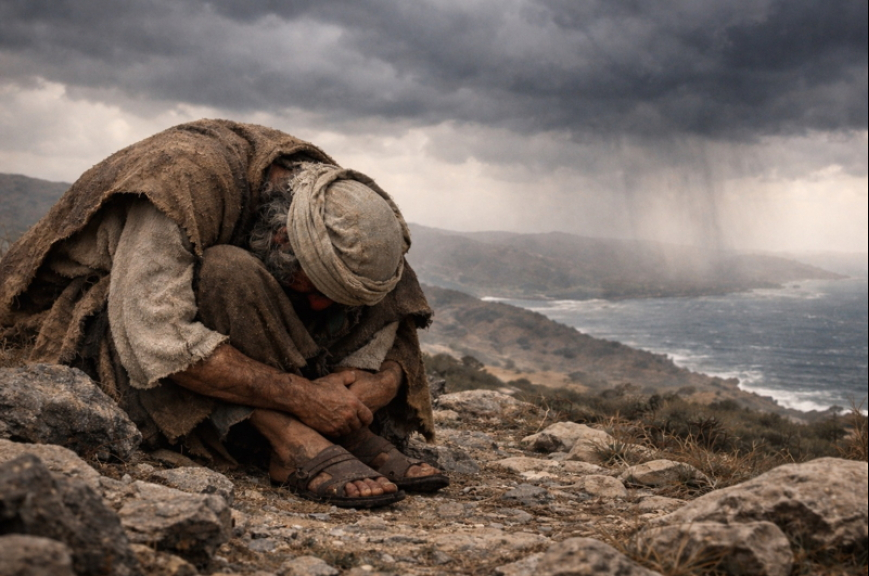
And Elijah said to Ahab, “Go up, eat and drink, for there is a sound of the rushing of rain.” So Ahab went up to eat and to drink. And Elijah went up to the top of Mount Carmel. And he bowed himself down on the earth and put his face between his knees. And he said to his servant, “Go up now, look toward the sea.” And he went up and looked and said, “There is nothing.” And he said, “Go again,” seven times. And at the seventh time he said, “Behold, a little cloud like a man's hand is rising from the sea.” And he said, “Go up, say to Ahab, ‘Prepare your chariot and go down, lest the rain stop you.’” And in a little while the heavens grew black with clouds and wind, and there was a great rain
HOW ELIJAH WON HIS SPIRITUAL BATTLES
A. By Seeing with Eyes of Faith. Elijah tells Ahab to eat and drink “for there is the sound of the rushing rain.” Notice the coordinating conjunction for. The reason to eat and drink is that it is going to rain. Elijah appears to be saying to Ahab, “Go celebrate. The end of the drought has come. Rain is on the way.” It is doubtful that Elijah heard a physical sound of rushing rain. He had yet to climb to the top of Mt Carmel and when he did so, his servant revealed that the sky was blue. More likely is that Elijah knew rain was on the way through the eyes of his faith—because he trusted God’s promise. He knew what God had clearly stated he would do in Deuteronomy 11:13-27.
“And if you will indeed obey my commandments that I command you today, to love the Lord your God, and to serve him with all your heart and with all your soul, he will give the rain for your land in its season, the early rain and the later rain, that you may gather in your grain and your wine and your oil. And he will give grass in your fields for your livestock, and you shall eat and be full.
Because Elijah knew that Yahweh was a promise-keeping God, he knew that God had sent the drought because of its false worship of Baal and Asherah. He saw God turning the people’s hearts back to Yahweh, after God sent the fire. He also knew that the evil worship of false God’s had been atoned for by the sacrifice of the bull on behalf of the people’s sin, and that their repentance was confirmed by their execution of the prophets of the two false religions. Therefore, Elijah trusted God to send the rain.
Scripture says, “Faith is the assurance of things hoped for the conviction of things unseen.” It deals with two invisible realms, the future and the present unseen world. “The assurance of things hoped for means trusting God’s promises for the future.” It means claiming God’s promises, leaning upon them, trusting them. Elijah trusted God to send rain, so he told Ahab to go celebrate the end to the drought. Here is a great list of promises to for us to trust God to keep:
- Lamentations 3:22-23: The steadfast love of the Lord never ceases; his mercies never come to an end; they are new every morning; great is your faithfulness.
- Phil 4:19: My God will supply every need of yours according to his riches in glory in Christ Jesus.
- Psalm 34:10: The young lions suffer want and hunger; but those who seek the Lord lack no good thing.
- Romans 8:31-32: If God is for us, who can be against us? He who did not spare his own Son but gave him up for us all, how will he not also with him graciously give us all things?
- Romans 8:28-29: For those who love God all things work together for good, for those who are called according to his purpose. For those whom he foreknew he also predestined to be conformed to the image of his Son.
- James 1:5: If any of you lacks wisdom, let him ask God, who gives generously to all without reproach, and it will be given him.
- Phil 4:6-7: Don’t worry over anything whatever; tell God every detail of your needs in earnest and thankful prayer, and the peace of God which transcends human understanding, will keep constant guard over your hearts and minds as they rest in Christ Jesus.
- Isaiah 4:31-32: Even youths shall faint and be weary, and young men shall fall exhausted; but they who wait for the Lord shall renew their strength; they shall mount up with wings like eagles; they shall run and not be weary; they shall walk and not faint.
- Proverbs 3: 9-10: Honor the Lord with your wealth and with the firstfruits of all your produce; then your barns will be filled with plenty, and your vats will be bursting with wine.
- Prov 3:5-6. Trust in the Lord with all your heart, and do not lean on your own understanding. In all your ways acknowledge him, and he will make straight your paths.
Elijah saw rain coming through the eyes of faith. He was certain that God would keep his promises because he always does.
B. By praying for God’s will according to Scripture. As we said at the beginning of the study, Elijah didn’t just march into Ahab’s palace out of the blue. Yes, God sent him, but Elijah knew the Torah, specifically Deuteronomy 11, which warned, Take care lest your heart be deceived, and you turn aside and serve other gods and worship them; then the anger of the Lord will be kindled against you, and he will shut up the heavens, so that there will be no rain. Israel was worshipping Baal—thus Elijah presents God’s covenant sanctions—drought is coming. Then, when Israel repented on Mt. Carmel, Elijah knew that OTHER words from the same chapter of Scripture NOW applied. “And if you will indeed obey my commandments that I command you today, to love the Lord your God, and to serve him with all your heart and with all your soul, he will give the rain for your land in its season, the early rain and the later rain, that you may gather in your grain and your wine and your oil. Elijah knew that it was God’s will to send the rain. Elijah based his prayer request upon what he knew God’s will was from Scripture.
The Apostle John taught the same principle. He wrote: And this is the confidence that we have toward him, that if we ask anything ACCORDING TO HIS WILL he hears us. And if we know that he hears us in whatever we ask, we know that we have the requests that we have asked of him (1 John 5:14-15). But there is confusion about praying according to God’s will, because Scripture uses the phrase “God’s will” two different ways. This term can refer to God’s sovereign will i.e. whatever he has ordained to come to pass. In Acts 4:24 the believers refer to God’s sovereign will when they pray, “Sovereign Lord, who made the heaven and the earth and the sea and everything in them… for truly in this city there were gathered together against your holy servant Jesus, whom you anointed, both Herod and Pontius Pilate, along with the Gentiles and the peoples of Israel, to do whatever your hand and your plan had predestined to take place.”
But when it comes to prayer, “God’s will” is not referring to God’s sovereign will—that is going to be accomplished whether we pray or not. “God’s will” in the NT is also used for what pleases God, for what is called God’s his moral will. Paul refers in I Thes 4 to this “will of God.” “For this is the will of God, your sanctification: that you abstain from sexual immorality.” That is the category of “God’s will” to pray for! That sounds like what Paul would pray for the church members around the Mediterranean. For example, listen to what he prayed for the Colossians.
We have not ceased to pray for you, asking that you may be filled with the knowledge of his will in all spiritual wisdom and understanding, so as to walk in a manner worthy of the Lord, fully pleasing to him: bearing fruit in every good work and increasing in the knowledge of God; being strengthened with all power, according to his glorious might, for all endurance and patience with joy; giving thanks to the Father, (Col 1:9-12).
David Jeremiah writes
If we compare how Paul prayed for people with how we pray for others, we might be surprised. Often times we pray for someone to be healed of a sickness, find a good job, have a safe vacation, restore a relationship, and so on—things that have to do with our personal needs as individuals. Our prayers tend to be focused on the material, physical aspects of life. That's not to say God isn't concerned about the daily events that affect our lives because he is. But we cannot overlook the importance of praying for spiritual wisdom as well… The apostle Paul prayed continually for the saints and the churches he founded and ministered to, and when he prayed, he focused on the spiritual aspects of life. He prayed for increased love, power, discernment, knowledge of God's will—the very things Satan would attempt to take away from Christians in order to confuse, weaken, or discourage us.
Elijah shaped his prayers by what Scripture told him was God’s will. So should we. We can us Scripture’s list of godly feminine virtues to pray for our wives or Paul’s mention of his prayers for various churches as a guideline in praying for others.
C. By humbling himself. Body language tells a lot about a heart attitude. After Elijah climbed near the top of Mt. Carmel, we read, And he bowed himself down on the earth and put his face between his knees. Elijah had just won one of the greatest spiritual battles in history. Perhaps his heart was grieved by having to oversee the execution of 850 human beings who had been led astray by the Evil One. Perhaps he was thinking, but by the grace of God, I might have been one of those false prophets. Though himself the ultimate example of bold persistence in prayer, there was still a deep humility in making requests of God. Perhaps many prayers in his lifetime had not been answered exactly as he had expected. I doubt that he had expected to have to hide and pray for 3 and a half years before God brought repentance to Israel. Perhaps by this time in his life, he had the leathered, battle-worn humility of the one who said:
I asked for strength that I might achieve; he made me weak that I might obey. I asked for help that I might do great things; he gave me grace that I might do better things. I asked for riches that I might be happy; he gave me poverty that I might be wise. I asked for power that I might have the praise of men; he gave me weakness that I might feel the need of God. I ask for all things that I might enjoy life; he gave me life that I might enjoy all things. I received nothing I had asked for; he gave me all that I had hoped for. (Michael Green).
Elijah first emptied himself. Then he asked for rain to return to the kingdom.
D. By persevering through unanswered prayer. The most distinctive characteristic of Elijah was his persistence in prayer.
And he said to his servant, “Go up now, look toward the sea.” And he went up and looked and said, “There is nothing.” And he said, “Go again,” seven times. And at the seventh time he said, “Behold, a little cloud like a man's hand is rising from the sea.” And he said, “Go up, say to Ahab, ‘Prepare your chariot and go down, lest the rain stop you.’” And in a little while the heavens grew black with clouds and wind, and there was a great rain (1 Kings 18:43-45).
If Elijah only prayed three times a day but he did that for 3.5 years, he would have asked God over 3800 times to bring about repentance in the hearts of the people of Israel. When the widow’s son, died, Elijah did NOT lay his body over him and ask God to bring him back to life once. He did not stop after God did not answer him but stretched his body over the son a second time. No response from God. Finally, after the third time, God answered. Who knows how many times he would have stretched his body over the child and repeated the request. After this mighty triumph and the vindication of God’s holiness, the execution of false prophets, sacrifice for the people’s heinous disobedience to the very first commandment, and knowing the Scripture said, that faithful worship of Yahweh would cause him to send rain what does Elijah experience after his prayer for rain—nothing. The only kind of prayer Elijah knew was prevailing prayer—prayer that will not stop until it prevails over everything opposing it. After 1200 days of praying and the mighty showdown with the prophets of Baal, God still requires Elijah to prevail in prayer—to not stop until God answers it. That is the kind of prayer Jesus pointed to in the parable of the widow and the unjust judge in Luke 18:2-5.
And he told them a parable to the effect that they ought always to pray and not lose heart. He said, “In a certain city there was a judge who neither feared God nor respected man. And there was a widow in that city who kept coming to him and saying, ‘Give me justice against my adversary.’ For a while he refused, but afterward he said to himself, ‘Though I neither fear God nor respect man, yet because this widow keeps bothering me, I will give her justice, so that she will not beat me down by her continual coming.
As Bill Hybels points out in his book, Too Busy NOT to Pray, a lot of readers make a grave error in interpreting this story.
Thinking of it as an allegory they look at it like this: We humans are like the widow, impoverished, powerless, with no connections and no status… God then must be like the judge. He's not really interested in our situation. After all he has a universe to run, angels to keep in harmony, harps to tune. It's best not to bother him unless it's really important. But if we're desperate, we can always do what the widow did. We can pester him. Bang on the doors of heaven. Spend hours on our knees. Ask our friends to pester him too. Sooner or later, we might wear him down and wrench a blessing from his tightly closed fist.
However, such an interpretation is completely wrong. This is a parable of contrast. We are nothing like the widow. She was destitute, powerless, forgotten, and abandoned. She had no relationship with the judge. In fact, we are totally opposite to her. We are the beloved children of the judge in fact his cherished bride. God is nothing like the unjust judge, who was crooked, unfair, disrespectful, uncaring. God is just, holy, compassionate, tender, responsive, loving. Jesus’ point is PERSISTENCE. If persistence works between an abandoned widow with no standing and a corrupt selfish judge, HOW MUCH MORE will a loving Father and Bridegroom respond to the requests of his beloved!
Elijah is an example of prevailing prayer that continues until it prevails. A few years ago, a group from la Habra Christian Church in Los Angeles was in a Cambodian village, evangelizing door-to-door. The remote Cambodian village had not seen rain in two years, and they believed it was because the local Mountain God was angry with them. During one house visit, a local woman asked Pastor Jason Kim, “Can Jesus God make it rain?” Pastor Kim answered, “Yes, Jesus CAN make it rain.” But apparently the translator messed up because she heard not, “Jesus CAN make it rain,” but “Jesus God WILL make it rain.” The word spread like wildfire throughout the entire village, “Jesus WILL make it rain.”
The rest of Kim’s team was furious with him for putting the Lord to the test. But they prayed like crazy starting early the next day. “We’re so sorry that we accidentally put your name to the test. But now, please show these villagers that you are God, by making it rain.” Hour after hour they prayed all day long. Nothing. The next day dawned bright and sunny. They prayed hour after hour, all day and into the evening. Nothing. The third day shortly after dawn, the sky darkened, then exploded, raining buckets. The missions team decided to gather in a pavilion to begin a worship service. The villagers poured in shouting “Jesus God made it rain. Jesus God made it rain.” The pastor asked who wanted to leave the Mountain God to follow Jesus God. Nearly the whole village stood up and gave their lives to Jesus.
Prevailing prayer prevails over circumstances, the kingdom of darkness, our own weariness, and our unbelief. Prevailing prayer has only one endpoint: when the answer comes. That was the approach of Elijah.
For Further Prayerful Thought
- What is the relationship between prayer and our mission from Jesus to seek first the kingdom of God and his righteousness?
- Elijah demonstrated faith, which is the assurance of things hoped for, in other words, counting on keeping God’s promises in the future. Which of the ten promises mentioned seemed most relevant to your faith walk right now?
- What would prevent you from taking 15 minutes to examine what Paul prayed for his churches and Paul’s list of feminine virtues in Titus 2 and start to pray for God to strengthen your loved ones in those areas?
- What would you say about Elijah’s example if you were trying to encourage and younger Christian to persevere in prayer?


