Tuesday's midterm election, typified by Virginians passing amendments to their constitution allowing more babies to be aborted and children to mutilate their bodies because of their gender confusion, was a victory for the Kingdom of Darkness. Sadly, as we have noted during this study of Israel, political leaders like King Solomon, King Jeroboam, and King Ahab have enormous power to lead the citizens of their nations into evil. That will happen because of votes on Tuesday. Yet, that power is limited. One who knew well the rise and fall of political power was Chuck Colson. In his book, Kingdoms in Conflict, he provides a wise perspective:
When Jesus said to Pilate, “My kingdom is not of this Earth,” Pilate may have breathed a sigh of relief. He should have reconsidered. Which is more threatening to a ruler—an external foe with mighty but visible armies or an eternal king who rules the very souls of men and women? The latter can command the will and affections, demand absolute obedience, impart unlimited power to his subjects, and radically change their values and lives. His followers fear no Earthly power and His Kingdom has no end. In the face of such a potentate, any mere political leader must shudder. This is why the Kingdom of God has had such an astonishing effect upon the most powerful of human empires in every age.
Colson recognizes what Paul made clear. We do not wrestle against flesh and blood, but against the rulers, against the authorities, against the cosmic powers over this present darkness, against the spiritual forces of evil in the heavenly places (Eph. 6:12). From the day Adam and Eve joined Satan’s rebellion and God promised a Messiah who would one day crush Satan’s head, the kingdom of darkness has fought against God’s Covenant people, members of the kingdom of light. This episode examines the great victory of the Kingdom of Light over the Kingdom of Darkness led by Elijah to see what lessons we can learn to be better equipped to fight for Christ’s kingdom to prevail over Satan’s kingdom of Evil.
Jesus said that he would build his church and the gates of hell would not prevail against it. From a band of 120 followers at the time of Jesus’ death, Christianity has spread to include 2.3 billion and has adherents in every one of the roughly 195 nations of the world. Even in the secularized West, where there is a significant increase in the number of young adults who answer “none” when asked to identify their religious affiliation, almost all the new religiously unaffiliated come not from Bible-believing religious groups but from liberal ones (see Keller, Making Sense of God. p. 24). Looking through a slightly different lens, the western cultural emphasis on individualism has led to the decline of “inherited religion,” which includes those who attend mainline churches “because they were brough up that way.” Keller continues: “What is not declining in modern societies is “chosen religion,” religion based not on ethnicity or solely on upbringing but on personal decision. For example, only evangelical Protestants among all religious bodies in the United States are converting more people than they are losing (Ibid p. 26). The spread of Christ’s Kingdom outside the West has been explosive. Keller continues (writing in 2016).
In the non-western world the growth of Christianity is stunning. Last Sunday there were more Christians attending church in China than there were in all of “Christian Europe.” By 2020 Christianity will have grown from 11.4 million Christians in East Asia (China, Korea, Japan) in 1970 and 1.2% of the population, to 171.1 million and 10.5% of the population. In 1910 only 12 million people or 9% of Africa's population were Christians, but they will number 630 million or 49.3% of the population by 2020. Last Sunday in each of the nations of Nigeria, Kenya, Uganda, Tanzania, and South Africa there were more Anglicans in church than there were Anglicans and Episcopalians in all of Britain and the US combined.
Christians will never escape the need to battle with the kingdom of darkness until Jesus finally returns when Satan, sin, and death will be more than defanged, they will be utterly annihilated. Until then, we fight continually. So, there is much we can learn from Elijah’s victory over the worship of Baal on Mt. Carmel. As we return to the story, God has commanded Elijah, “Go, show yourself to Ahab, and I will send rain upon the earth.” So, Elijah finds him. In 1 Kings 18:19 we pick up the story with Elijah saying to Ahab. 19 Now therefore send and gather all Israel to me at Mount Carmel, and the 450 prophets of Baal and the 400 prophets of Asherah, who eat at Jezebel's table.”20 So Ahab sent to all the people of Israel and gathered the prophets together at Mount Carmel.
Over the past few weeks, we've been seeing Elijah watch the all-powerful King Ahab and his sinister wife lead his beloved country, Israel, down the path of destruction. They were like naive lambs, spiritually blind as they were led to the slaughter. The worship of Baal and Asherah was being substituted for the worship of the true God, Yahweh. The true prophets of Yahweh were being hunted down and systematically murdered. The once great nation, Israel, God's own people whose glorious spiritual heritage was being stolen by the prophets of Baal and the prophets of Ashtaroth, was succumbing to rampant idolatry. God's people were losing the battle for their culture; the nation was storing up wrath for itself. But finally God graciously steps into the ring, and we have the fight of the century: Yahweh vs. Baal. It is literally a showdown between the living God of heaven and the idols of men behind whom are demonic powers. And in a real sense this was a fight to the finish.
21 And Elijah came near to all the people and said, “How long will you go limping between two different opinions? If the Lord is God, follow him; but if Baal, then follow him.” And the people did not answer him a word. 22 Then Elijah said to the people, “I, even I only, am left a prophet of the Lord, but Baal's prophets are 450 men. 23 Let two bulls be given to us, and let them choose one bull for themselves and cut it in pieces and lay it on the wood, but put no fire to it. And I will prepare the other bull and lay it on the wood and put no fire to it. 24 And you call upon the name of your god, and I will call upon the name of the Lord, and the God who answers by fire, he is God.” And all the people answered, “It is well spoken.” 25 Then Elijah said to the prophets of Baal, “Choose for yourselves one bull and prepare it first, for you are many, and call upon the name of your god, but put no fire to it.”
Back in verse 21 Scripture says, “But the people said nothing,” which is what most people do. They sit quietly back and make no commitment. They remained silent. But Elijah wasn't silent. He laid out the rules of the contest (vs. 22-25). Picture a wide, grassy meadow, like a football field part way up the mountain. On one sideline are gathered 450 prophets of Baal and 400 prophets of Asherah—850 on one sideline. On the other sideline is Elijah by himself. In the two end zones, not sure which side to cheer for, sit the people. Elijah deliberately stacks the deck against Yahweh:
- Baal has 850 priests and prophets to pray. Yahweh has one. That's 850 times more people to offer sacrifices and pray.
- Elijah lets the prophets of Baal choose the better of the two bulls.
- The challenge to send fire was supposedly Baal’s specialty. He was the rain God who sent the lightning and thunder. Baal was supposed to be the source of fire and lightning. Surely if he could do anything he could send lightning down and start a fire.
26 And they took the bull that was given them, and they prepared it and called upon the name of Baal from morning until noon, saying, “O Baal, answer us!” But there was no voice, and no one answered. And they limped around the altar that they had made. 27 And at noon Elijah mocked them, saying, “Cry aloud, for he is a god. Either he is musing, or he is relieving himself, or he is on a journey, or perhaps he is asleep and must be awakened.” 28 And they cried aloud and cut themselves after their custom with swords and lances, until the blood gushed out upon them. 29 And as midday passed, they raved on until the time of the offering of the oblation, but there was no voice. No one answered; no one paid attention.
So, the prophets of Baal choose the bull, cut it up, place it on the altar and begin to pray to Baal from morning all the way till noon. You can imagine 850 prophets all pleading at the same time: Oh Baal. Oh Baal. Please answer me. They danced around the altar in every correct ceremony they could think of. But no response. At noon Elijah began to taunt them. Elijah's making fun of their religion. Elijah, don't you know it's not politically correct to make fun of someone's religion. Elijah, don't you realize that all religions are basically the same—many paths leading to the same God. Elijah continues to mock them.
- “Keep calling out to him. After all he is supposed to be a god.”
- “Call out with a louder voice he must be musing, i.e. deep in thought. After all you've got to yell louder if someone is meditating.”
- “Maybe he is relieving himself. Yell a little louder, maybe Baal is in the outhouse and he can’t hear.” If you ever wondered whether or not God has a sense of humor, you have the answer.
- “Maybe he’s on a journey.”
- “Maybe he’s asleep. Yell louder so you can wake him up.”
Verse 28 tells us that the false prophets intensified their requests, slashing themselves, mutilating themselves. We know historically what Baal worship looked like. So, one historian fills in the dots in the biblical account
Stung to madness they became more frantic than before. And what we know as the second and third acts in these feasts ensued, the wild howl passed into piercing demonical yells. In their madness the priests bit their arms and cut themselves with the two-edged swords, which they carried and with lances. The blood began to flow, the frenzy reached its highest pitch, when first one, then others, commenced to prophecy, moaned and groaned, then burst into rhapsodic cries, accusing themselves or speaking to Baal, or uttering incoherent broken sentences. All the while they beat themselves with heavy scourges, loaded or armed with sharp points, and cut themselves with swords and lances—sometimes even mutilated themselves—since the blood of the priests was supposed to be specially propitiatory with Baal. (Theodore Epp, Elijah A Man of Like Nature).
Elijah allowed this frenzied worship of demons to continue about three more hours. Then we read.
Then Elijah said to all the people, “Come near to me.” And all the people came near to him. And he repaired the altar of the Lord that had been thrown down. 31 Elijah took twelve stones, according to the number of the tribes of the sons of Jacob, to whom the word of the Lord came, saying, “Israel shall be your name,” 32 and with the stones he built an altar in the name of the Lord. And he made a trench about the altar, as great as would contain two seahs of seed. 33 And he put the wood in order and cut the bull in pieces and laid it on the wood. And he said, “Fill four jars with water and pour it on the burnt offering and on the wood.” 34 And he said, “Do it a second time.” And they did it a second time. And he said, “Do it a third time.” And they did it a third time. 35 And the water ran around the altar and filled the trench also with water.
In verse 30, Elijah rebuilds an altar to Yahweh. Perhaps it had been torn down torn down by the agents of Jezebel. He uses 12 Stones signifying the 12 tribes of Israel pointing to the earlier days when all 12 were together. That was the covenant heritage of God's people. The altar and the bull are significant for another reason. A sacrifice needed to be offered for the sins of the people who had shattered the first commandment, “You shall have no other gods before me.” Without the shedding of blood there is no remission of sin (Heb. 9:22). This of course is a type, a foreshadow, a preview of Christ the lamb of God who takes away the sins of the world. So when the fire falls so it should have consumed the people. But the wrath of God was propitiated; it was turned away by the grace of God and the fire instead consumes the sacrifice.
Next, Elijah says to fill four large jugs with water these were not one quart jars the word actually means barrels the question comes up where did the water come from of course a bunch of liberals want to say well this just goes to point out the fact that the bible's stories aren't true well where did the Bible come from it came from the Mediterranean Sea because remember Mount Carmel is right next to the Mediterranean Sea you can't drink that water but it puts out fires just fine so three times he soaks the altar once again stacking the odds against Yahweh and in favor against Yahweh.
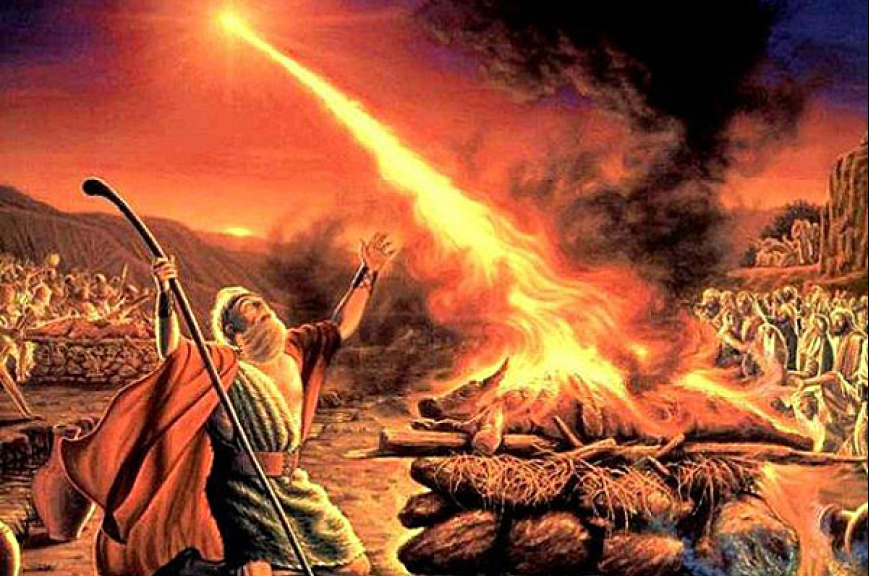
36 And at the time of the offering of the oblation, Elijah the prophet came near and said, “O Lord, God of Abraham, Isaac, and Israel, let it be known this day that you are God in Israel, and that I am your servant, and that I have done all these things at your word. 37 Answer me, O Lord, answer me, that this people may know that you, O Lord, are God, and that you have turned their hearts back.” 38 Then the fire of the Lord fell and consumed the burnt offering and the wood and the stones and the dust, and licked up the water that was in the trench. 39 And when all the people saw it, they fell on their faces and said, “The Lord, he is God; the Lord, he is God.” 40 And Elijah said to them, “Seize the prophets of Baal; let not one of them escape.” And they seized them. And Elijah brought them down to the brook Kishon and slaughtered them there.
Though the text doesn't say this, I suspect that if there was anybody standing near the altar at this point, Elijah would have asked them to move away! So, here’s the setting: 850 prophets had prayed to Baal for six hours and nothing happened. Eijah's prayer was 63 words in English. It took 20 seconds and the fire fell! (Parenthetically, I would be very suspicious of any prayer service or healing service that works people up into a frenzy, experiencing ecstatic utterances. In Scripture, this behavior is much more closely identified with the worship of Satan, who masquerades as an agnel of light, than with prayer to the true God.)
Verse 38. The fire fell from heaven. A fire usually starts at the bottom and works up. But notice that in this case the fire started at the top and worked down. And the people fell on their faces and cried, “Yahweh, he is God. Yahweh, he is God.” If the people knew their biblical history well, they would have remembered two other times when God had sent fire from heaven to consume their sacrifice.
- In Leviticus 9:24 when worship took place for the first time in the Tabernacle
- In 2 Chronicles 7:1–3, when worship took place for the first time in the Temple Solomon was dedicating.
Verse 40. Elijah commands the false prophets to be put to death. Doesn't that seem a little harsh? But what would we think of a physician who sees a CAT scan and sees a mass in an abdomen who says, “I'm going to remove just some of the cells. Major surgery would be too painful.” We would go to another doctor. We know we need major surgery to take the tumor all out and with it some surrounding areas that could be contaminated. There was a spiritual malignancy in the land; it needed to be dealt with. It was very clearly a capital offense in Israel to seek to entice another to worship a false God. Deuteronomy 13:1-5 says, “If a prophet appears among you…. and he says let us follow other gods… That prophet or dreamer must be put to death because he preached rebellion against Yahweh your God who brought you out of Egypt and redeemed you from the land of slavery; he has tried to turn you from the way Yahweh your God commanded you to follow. You must purge the evil from among you.” Ending the life of these false prophets was also merciful of God from the viewpoint of eternity, preventing them from incurring any worse judgement upon themselves by luring the people into worshipping Baal again.
5 LESSONS TO BE LEARNED
Lesson #1: Biblical faith is based on evidence. This story is about God proving he is the true God and Baal and Asherah were false gods. Biblical faith is not an irrational leap; it is always based on evidence.We live in a scientific age dominated by naturalism, which assumes that the natural, physical world is all there is. Science deals strictly with empirical evidence from within this natural order. So, by definition, science cannot prove the existence of a being outside of nature. Since science is incapable of proving (or disproving) the existence of God, belief in God is often understood as a blind, irrational, leap of faith. But science is not the same as logic. The idea that faith conflicts with reason is nonsense. The Christian church doesn’t believe what it does IN SPITE OF reason, but BECAUSE OF reason. Peter commands Christians, always be prepared to make a defense to anyone who asks you for a reason for the hope that is in you (1 Pet. 3:15). Both the Greek word for defense (APO-LOGIA, from which we get the word apologetics) and the word for reason (LOGOS) contain the Greek term LOGOS, from which we get the term logic.
Christians do not crucify their brains to become believers. It is much more logical to believe in the existence of God than not to. Paul’s argument is that the empirical evidence resulting from observing creation proves that there must be an “Orderer” outside the universe (Rom. 1:20). It is much more logical to believe in the resurrection based on the evidence than not to. It is much more logical to realize through archeology and fulfilled prophecy that the Bible is inspired by God than not to.
Lesson # 2: One plus God equals a distinct majority. Elijah was on one sideline 850 prophets of Baal and Asherah were on the other side. Divine mathematics is very different from human math. We believe there is power in numbers. Those numbers mean nothing to God. In nearly all the Old Testament battle stories God's people are way, way, outnumbered. Do you ever feel in the minority as a Christian at work, at school, in the neighborhood, in the culture? I do, Ever think to yourself “I'm alone here. I'm the only one who sees this. I'm the only one who's fighting for this I'm the only one who sees how destructive these actions are. I'm the only voice for God.” One of the great lessons here is the way that God sustained Elijah all the way on this lonely path, which, by the way, is going to lead to depression.
Lesson # 3: Don't focus on the size of your challenges focus on the size of your God. That is a tremendous lesson. How often Elijah could have focused on the size of his problems:
- When he was sent to Ahab at the very beginning to announce the drought. What if Ahab grabs me and kills me right then and there?
- When he went to the brook where there was no food. Did I hear God right when he said he would send bread and meat to me twice a day through unclean ravens?
- When the brook dried up and he had to travel 100 miles. I have no idea where I will be able to find food or water for this trip
- When he finds the widow, but she is totally destitute herself. Great. Now I have to depend upon HER faith to supply flour and oil.
- When the widow's son died and the widow blames Elijah. The one person in the nation I am depending upon and you allow her son to die and blame me?
- When he stands and faces a whole nation? What if I didn’t understand God’s leading correctly?
Elijah somehow chose to focus on the size of his God instead of on the size of his problem. That's what it means to live by faith.
Lesson #4: Our most effective weapon in the spiritual battle is prayer. In this huge spiritual conflict which God was first preparing Elijah for and then enabling him to win every time God's hand moved on Elijah's behalf it came as a result of prayer. Elijah is held out to us in the NT in James as the example par excellence of prayer. We'll talk more about this next week as we see Elijah praying for the rain to fall. But thinking about the direction of our nation I realize there are many challenges to spreading the biblical worldview in our culture not the least of which are the antibiblical influence of social media, and academia. But I don't think it's any coincidence that we are also one of the most prayerless generations in America’s history. Missionary Wesley Duewel says it well.
THE GREAT NEED of our world, our nation, our churches is people who know how to prevail in prayer. Moments of pious wishes blandly expressed to God once or twice a day will bring little change on earth or among the people. Kind thoughts expressed to him in five or six sentences after reading a paragraph or two of mildly religious sentiments, one a day from some devotional writing will not expand the kingdom of God or shake the gates of hell and repel the attacks of evil on our culture and our civilization.
Lesson #5: Half-hearted devotion to God nauseates him. Elijah put it to the people. “How long will you waver between two opinions? If Yahweh is God follow him. If Baal follow him. Stop sitting on the fence.” Some of the strongest words in Scripture are directed in the book of Revelation to the church members who lived in Laodicea. “‘I know your works: you are neither cold nor hot. Would that you were either cold or hot! So, because you are lukewarm, and neither hot nor cold, I will spit you out of my mouth.” In masculine language, perhaps this would read, “Give me a hot cup of coffee in the morning or a cold beer in the afternoon. But don’t give me a lukewarm soda.” Partial commitment to Jesus nauseates him. He is worthy of nothing less than supreme loyalty, one hundred percent of ourselves to one hundred percent of Jesus. Nothing held back. Extreme allegiance. God forbid that we are ever satisfied with the bar of our devotion to Jesus set at mediocrity.
For Further Prayerful Thought
- What most stands out to you about this battle between Elijah and the false prophets on Mt. Carmel?
- What do you think was the place of logical reason in the approach that Elijah took to disproving the claim of Baal’s prophets that he was God?
- Why would lukewarmness be repulsive to Jesus? Wouldn’t that be better than being hostile to him?
- What do you think of the challenge when facing big problems to resist focusing on the size of the problems but to instead focus on the size of our God?


