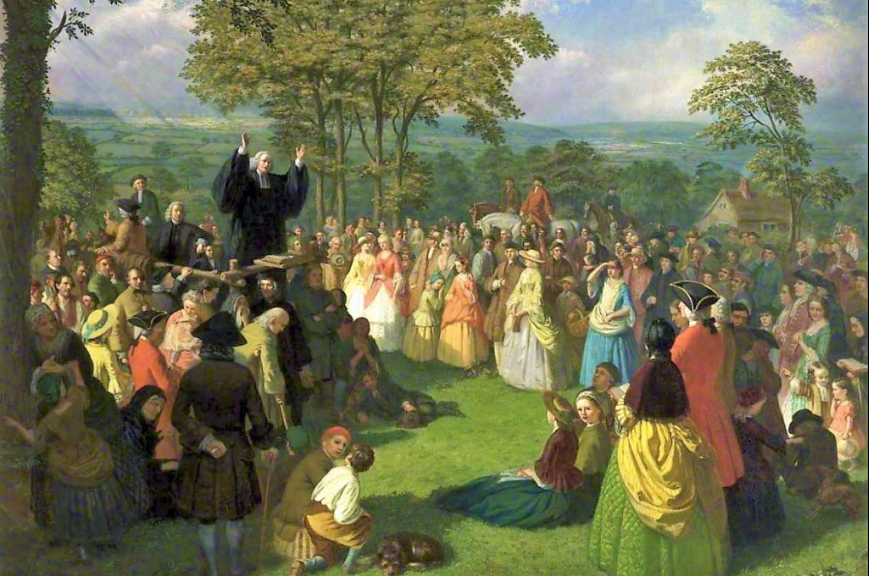
One of the films making its rounds the past two weeks in movie theaters is “A Great Awakening” produced by Sight and Sound. The film tells the story of the First Great Awakening in America through the lens of Benjamin Franklin, the friend of George Whitefield, the great preacher who was largely responsible, along with Jonathan Edwards, for the awakening, which historians say had a tremendous impact on the founding of America thirty years later. If you can still catch it at your theater, it is well worth seeing.
One of the primary responsibilities of Christians is to impact their culture, retarding the decay brought about by sin by functioning as salt and shining the light of God's truth into spheres of our own culture where the darkness of sin prevails. In other words, Christ wants us not only to be individual disciples of his but to make disciples of all nations. In this episode we find insight about this process as we look at how God discipled nations in the past by bringing about a great awakening and spiritual renewal in Israel (recounted in Nehemiah 8) and inspiring The Great Awakening in America.
Nehemiah 8:1-18
Context. Chapter seven describes the return to Jerusalem of many Jews, causing Jerusalem’s population to rise to over 40,000.00. One of the priests, perhaps Ezra, seems to have noticed that according to Leviticus 23, God had spelled out some celebrations that were to take place in the seventh month of the year. One of these, called the Feast of Trumpets, was to take place on the first day of the month. Leviticus 23:23 said, And the Lord spoke to Moses, saying, “Speak to the people of Israel, saying, In the seventh month, on the first day of the month, you shall observe a day of solemn rest, a memorial proclaimed with blast of trumpets, a holy convocation. You shall not do any ordinary work, and you shall present a food offering to the Lord.”
As we come to Nehemiah 8, the Jews of Jerusalem had just turned over their calendar from the Elul the sixth month of their calendar to Tishri, the seventh month. The last verse of chapter 7 says, And when the seventh month had come, the people of Israel were in their towns.
Nehemiah 8:1-12. All the people came together as one in the square before the Water Gate. They told Ezra the teacher of the Law to bring out the Book of the Law of Moses, which the LORD had commanded for Israel. So on the first day of the seventh month Ezra the priest brought the Law before the assembly, which was made up of men and women and all who were able to understand. He read it aloud from daybreak till noon as he faced the square before the Water Gate in the presence of the men, women and others who could understand. And all the people listened attentively to the Book of the Law.
Ezra the teacher of the Law stood on a high wooden platform built for the occasion. Beside him on his right stood… Ezra opened the book. All the people could see him because he was standing above them; and as he opened it, the people all stood up. Ezra praised the LORD, the great God; and all the people lifted their hands and responded, “Amen! Amen!” Then they bowed down and worshiped the Lord with their faces to the ground. The Levites (13 are listed)—instructed the people in the Law while the people were standing there. They read from the Book of the Law of God, making it clear and giving the meaning so that the people understood what was being read.
Then Nehemiah the governor, Ezra the priest and teacher of the Law, and the Levites who were instructing the people said to them all, “This day is holy to the Lord your God. Do not mourn or weep.” For all the people had been weeping as they listened to the words of the Law. Nehemiah said, “Go and enjoy choice food and sweet drinks, and send some to those who have nothing prepared. This day is holy to our LORD. Do not grieve, for the joy of the Lord is your strength.” The Levites calmed all the people, saying, “Be still, for this is a holy day. Do not grieve.” Then all the people went away to eat and drink, to send portions of food and to celebrate with great joy, because they now understood the words that had been made known to them.
In the next part of the Nehemiah text, the leaders discover a second feast that was to be observed in the seventh month, the Feast of Booths. Leviticus 23:33 ff explains it. And the Lord spoke to Moses, saying, “Speak to the people of Israel, saying, On the fifteenth day of this seventh month and for seven days is the Feast of Booths to the Lord.”
Nehemiah 8:13-18. On the second day of the month, the heads of all the families, along with the priests and the Levites, gathered around Ezra the teacher to give attention to the words of the Law. They found written in the Law, which the LORD had commanded through Moses, that the Israelites were to live in temporary shelters during the festival of the seventh month and that they should proclaim this word and spread it throughout their towns and in Jerusalem: “Go out into the hill country and bring back branches from olive and wild olive trees, and from myrtles, palms and shade trees, to make temporary shelters”—as it is written.
So the people went out and brought back branches and built themselves temporary shelters on their own roofs, in their courtyards, in the courts of the house of God and in the square by the Water Gate and the one by the Gate of Ephraim. The whole company that had returned from exile built temporary shelters and lived in them. From the days of Joshua, son of Nun, until that day, the Israelites had not celebrated it like this. And their joy was very great. Day after day, from the first day to the last, Ezra read from the Book of the Law of God. They celebrated the festival for seven days, and on the eighth day, in accordance with the regulation, there was an assembly.
There is a certain aura of dignity about the scene in Jerusalem. Ezra comes out carrying the scrolls. He mounts the stairs of the platform. He takes his position facing the people flanked by six church officials on his right and seven on his left. As he opened the book of the law, the people stood up out of reverence for the Word of God. Ezra led the people in praise given to Yahweh, their awesome God who had brought his people back from captivity and enabled them to rebuild the temple and wall around Jerusalem. The people knelt down and worshipped with their faces to the ground. Then Ezra and the Levites taught the Word of God to the people for six straight hours from sunup at 6:00 AM till 12 noon. And the people, we're told in verse 3, listened attentively. Many of them had not heard the Word of God for many years. Some had probably not heard it at all. It was a spiritual feast for their famished souls as they sat in rapt attention. I can't help but think of Jesus' words, “Man does not live by bread alone but by every word that proceeds from the mouth of God.”
I'm reminded of a Christian couple who were touring Russia. They'd left a copy of the Gospel of John in Russian by their bedside table in their motel. When their maid saw it she begged them to give it to her, explaining that she was a believer, that her Bible had been destroyed in the German siege of Leningrad, and that she'd been praying for a Bible for 30 years. The couple gladly gave the maid a small copy of the whole Russian Bible. The next morning the maid met the couple in the hall and said, “I had to see you. I must thank you again for the precious gift. For 30 years I've been praying for a Bible. I have regularly prayed and life is good when I pray. But now I have a Bible! Last night I stayed up most of the night to read it.”
Her soul was so starved for the nutritious milk and meat of God's Word that exhaustion could not keep her from it. What a challenge to our attitude about the priceless Word of God.
How a Nation is Transformed
Verse eight reveals the way a nation is transformed, because ideas have consequences. The verse says, “They read from the Book of the Law of God, making it clear and giving the meaning so that the people understood what was being read.” The primary instrument for restoring fallen broken sinners to wholeness is the Word of God. David understood this transforming power. Notice the “impact” words of Psalm 19:7-11.
The law of the Lord is perfect, restoring the soul; the testimony of the Lord is sure, making wise the simple; the precepts of the Lord are right, rejoicing the heart; the commandment of the Lord is pure, enlightening the eyes; the fear of the Lord is clean, enduring forever; the statutes of the Lord are true, and righteous altogether. More to be desired are they than gold, even much fine gold; sweeter also than honey and drippings of the honeycomb. Moreover, by them is your servant warned; in keeping them there is great reward.
Notice back in Nehemiah three steps in the transformational process of presenting the Word of God. They read from the Book of the Law of God, making it clear and giving the meaning so that the people understood what was being read.
A. It began with Scripture being read. This common characteristic of nation-wide spiritual renewal was at the core of the Protestant Reformation. The Reformers translated the Bible into the people’s common languages so that ordinary people, not just clergymen, could read and understand it. Further, with the invention of the printing press by Johannes Gutenberg in Germany around 1440 just prior to the Reformation, Bibles could be affordably mass printed. John Wycliffe, known as the “morning star of the Reformation,” wrote the first English translation of the Bible in 1384. Following Wycliffe and influenced by reformer Martin Luther who translated the Bible into German, William Tyndale wrote the first modern English translation of the New Testament in 1526. All of that was preparation for the Reformation, Luther posting his 95 Theses in 1517. The Word of God transforms nations.
B. The teachers made the Word of God clear. This happens through understanding the cultural background, background of the word, context of the biblical text, and what kind of literary genre is being used in the text e.g. poetry verses historical narrative. The most important principle for interpretation, known as the Reformed hermeneutic, is that Scripture interprets Scripture. A text that could be taken several ways is to be taken in the way that is consistent with the rest of Scripture. Didactic passages are given higher value than historical narratives. David, who is a great example of a man after God’s own heart had multiple wives. But Deuteronomy 17:17 says of Israel’s king, He shall not acquire many wives for himself. David’s example here contradicted didactic teaching, so his example of taking more than one wife is not normative.
It is sometimes claimed that Acts 4:32 teaches communal property ownership and socialism as the biblical economic system. Now the full number of those who believed were of one heart and soul, and no one said that any of the things that belonged to him was his own, but they had everything in common. But the truth of the Bible can only be discovered through sound interpretive principles. To come to the truth we first look at the background. Thousands of Jews from across the Mediterranean world had traveled to Jerusalem to celebrate the Day of Pentecost, with the funds to travel, stay there just for Pentecost, then return home. But through Peter’s preaching thousands had come to faith in Christ. There was no Christian community, no preaching of the Word, no apostles to go home to. So, these baby Christians overstayed their funds in Jerusalem. There was such a spirit of love in the Body of Christ that the local believers not only took them in (the expected hospitality towards strangers) many sold propriety to pay for food while they awaited the leading of the Lord. Does such generosity support socialism?
Not at all. Socialism is not Christians being generous; it is state owned means of production, in contrast to private ownership. The fact is that these generous Christians in Acts 4:32 had to first own their property, before they could sell it to meet this urgent need. If the Bible taught socialism, the state would have owned that land. Didactic texts interpret historical texts. The didactic teaching of the Bible is that a free market system with protections for the poor is the economic system God wants. Two of the Ten Commandments teach private ownership, the 8th, You shall not steal, and 10th You shall not covet. The underlying biblical principle for economic flourishing is stewardship. It is developing the resources I have been given to reach their potential to make life better for the human community, and so provide for my own material needs and those of my family.
Satan, himself, quotes Scripture out of context. So, if we sincerely want God’s truth and not just a proof text to support our own desires, we must follow sound principles for interpreting Scripture. When rightly taught and interpreted, the Word of God is without equal in its power. The author to the Hebrews writes: “The word of God is living and active, sharper than any two-edged sword, piercing to the division of soul and of spirit, of joints and of marrow, and discerning the thoughts and intentions of the heart” (Heb 4:12).
C. The teachers gave it meaning so that the people understood what was read.
Jesus’ brother, James, was apparently very familiar with religious people who could tell you what Scripture taught but did not obey it in their own lives. He wrote, Be doers of the word, and not hearers only, deceiving yourselves (Ja 1:2). As Nehemiah 8 continues, the people immediately applied what they read in Leviticus 23. They discovered the command to celebrate the Feast of Booths from the 15th to the 22nd of the seventh month—that was Tishri, the month they were in. So, they got to work preparing to celebrate this feast on the 15th.
The Feast of Booths must have been the kids’ favorite holiday. What kid do you know who doesn’t get excited about camping out in the backyard? Every family spent two weeks outside finding wood, like families who go out to cut a Christmas tree. Next, they built their own lean-to with the wood. Then they celebrated a whole week while their family slept in the lean-tos each night. The reason they cancelled work, it is rumored, is because the dads and moms got so little sleep that they would have been totally worthless on the job! For seven days they were to feast and rejoice over their redemption from Egypt, Leviticus 23:42 You shall dwell in booths for seven days that your generations may know that I made the people of Israel dwell in booths when I brought them out of the land of Egypt. I am Yahweh your God. The bottom line was that God’s command to them was to stop working and take time to celebrate his blessings with their family. Nehemiah saw that at the heart of this revival was enjoying God. Back in verse 10, he had said to stop weeping and celebrate, “for the joy of the Lord is your strength.”
Listen to these commands from Paul, “Rejoice in the Lord always again I say rejoice.” “Delight yourself in the Lord.” The Israelites obeyed God’s command to celebrate the Feast of Booths and we read in verse 17, From the days of Joshua, son of Nun, until that day, the Israelites had not celebrated it like this. And their joy was very great.
The First Great Awakening in America
The First Great Awakening (1730s–1740s) was a massive religious revival that transformed the American colonies by shifting religious focus from formal church doctrine and structure to personal, experiences of faith. It emerged as a reaction against the growing secularism of the Enlightenment and a perceived spiritual “dryness” in established churches.
- Early Roots (1720s): The movement began locally in the Middle Colonies. Leaders like Theodorus Frelinghuysen (Dutch Reformed) and William Tennent (Presbyterian) emphasized heartfelt conversion over mere ritual performance.
- Regional Stirrings (1734–1735): The revival gained momentum in New England under Jonathan Edwards. His famous sermon “Sinners in the Hands of an Angry God,” described the terrifying consequences of sin and the urgent need for divine forgiveness, sparking hundreds of conversions. His preaching shook church goers out of their lethargy.
- The Intercolonial Peak (1739–1744): English preacher George Whitefield turned the local revivals into a national phenomenon. A master orator, Whitefield toured the colonies extensively, preaching to massive outdoor crowds that reached up to 30,000 people in places like the Boston Common. Here is Whitefield’s explanation from his own journal of what was happening: “The doctrine of the new birth made its way like lightening into the hearer’s consciences.”
Analysis: In 1840, ninety, years after The Great Awakening, a Vermont Bible-believing pastor, Joseph Tracy, conducted a thorough study of it. In his book, The Great Awakening, he gives some glimpses of the condition of the church in New England in the 1700’s. Remember the Declaration of Independence wasn’t written until 1776. The marriage of church and state governments had come over from Europe in the early days of the American colonies. Tracy explains, “In the early days of New England none but church members could hold any office or vote in elections. It always had been so throughout the Christian world, except that in most European cases the rulers were hereditary, so no church officer ever voted to approve their church membership.” Therefore, the motivation for admission to the Lord’s table was not a commitment to Christ: it was getting a job. Tracey continues,
“Throughout Christian Europe, the practice was to baptize all in infancy and to consider them as members of the church unless excommunicated in childhood. They were to be taught certain forms of faith and worship after which they were admitted to the Lord’s supper receiving confirmation from the Bishop (where there were bishops) and passing through an examination in the creeds and catechisms.” Tracy goes on to explain that this examination almost never sought to determine if the person had personally trusted Christ as his savior, come into a personal relationship with Christ, and chosen to follow him as Lord. BTW this neglect explains why many pastors, like John Wesley, were ordained and preaching before their conversion. Tracy continued,
“Exclusion from the Lord’s table was attended with the loss of certain civil rights and his excommunication would be followed by the infliction of punishment by the civil government. In England a man appointed to any civil or military office must qualify by receiving the Lord’s supper in the established church and many received it to qualify themselves for office who neglected it all the rest of their lives.” In short because of the marriage of church and state in a form somewhat like a theocracy, Christianity became a civil religion. But true Christianity is not an inherited one—inherited from your parents or from your culture. It is a chosen one. George Whitefield, Jonathan Edwards, and other preachers of the Great Awakening confronted their hearers with that choice. Repent. Believe. Surrender to Christ’s Kingship. We know that The Great Awakening brought new birth into the hearts of many nominal Christian church members. But the presentation of the true gospel also brought at least 25,000 new members into churches in New England alone.
Take Aways
- The Word of God transforms lives at the individual and national level.
- Christianity is not mental assent; it is an intentional choice of the will to follow Jesus and to seek first his kingdom and his righteousness.
For Further Prayerful Thought:
- Why do you think Jesus told us our mission is to “make disciples OF the nations” instead of “make disciples IN the nations”? What is the difference? What does this command say to Christians who want to give up on our culture because “the culture is so evil it is going to hell in a hand basket”?
- What stood out to you about how God discipled his nation, Israel, through Ezra and the Levites during the month of Tishri? What parts of this process seem applicable to America? Which parts don’t?
- What stood out to you about God discipling America through The Great Awakening? What lessons, if any, can you draw from it about how God might “disciple” America through us.


